






Spring Force Examples
Attention! Input results shown will be +/- 10% from middle value. Hint: The closer your min and max inputs are, the more accurate your results will be!
Attention! Input results shown will be +/- 10% from middle value. Hint: The closer your min and max inputs are, the more accurate your results will be!
Attention! Input results shown will be +/- 10% from middle value. Hint: The closer your min and max inputs are, the more accurate your results will be!
Understanding how to calculate spring forces is crucial for designing and implementing spring systems, especially for compression springs. By leveraging Acxess Spring's Online Spring Force Tester and Spring Creator 5.0, you can efficiently calculate spring force and determine optimal spring configurations for your needs. Below, we explore key concepts, formulas, and practical examples of spring calculations.
What is the Formula for Spring Force?
Compression springs absorb energy when compressed and release it as they return to their original shape, delivering a counteracting force. When a load compresses a spring, the spring pushes back with a force that is proportional to the load, governed by the spring constant or spring rate. The rate is a measure of the spring’s stiffness and determines how much load the spring can handle for each unit of compression. Understanding and calculating the spring rate ensures that the spring can withstand the specified load without losing elasticity or failing.
Formula: The compression spring force calculation is guided by the formula:
k = F / x
where:
- k (Spring Rate): Represents the spring's stiffness, usually expressed in pounds per inch (lb/in) or newtons per millimeter (N/mm). It defines how much force is required to compress the spring by one unit of length.
- F (Force): The total load or weight that compresses the spring, typically measured in pounds or newtons.
- x (Travel): The amount of compression, or the distance the spring compresses under the applied load, given in inches or millimeters.
The spring rate is the load that the spring can handle per unit of compression. For instance, a spring with a rate of 5 lb/inch requires 5 pounds of force to compress one inch.
Example Calculation
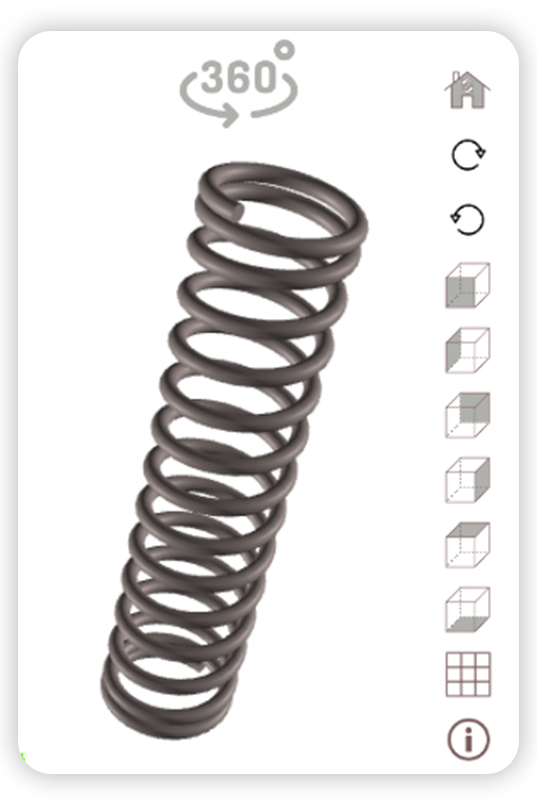
Let's imagine you are designing a compression spring for a precision scale used in a laboratory. The spring needs to compress by 0.774 inches when a 10 pounds force is applied, ensuring accurate measurements. The specifications for the spring are as follows:
|
Part Number |
PC056-500-14500-MW-2056-C-N-IN |
| Wire Diameter | 0.056 inches |
| Outer Diameter | 0.5 inches |
| Material Type | Music Wire |
| Total Coils | 14.5 |

Solving for k
Using the formula k = F ÷ x
k = 10 pounds ÷ 0.774 inches
k ≈ 12.92 pounds per inch
Using the Spring Constant
This means the spring constant k is approximately 12.92 pounds per inch. This value indicates the stiffness of the spring: for every inch the spring is compressed, it exerts a force of 12.92 pounds.
To ensure the spring works within the desired parameters, use Hooke's Law to check if the spring meets the requirements:
x = F ÷ k
x = 10 pounds ÷ 12.92 pounds per inch
x ≈ 0.774 inches
The calculated displacement matches the desired compression of 0.774 inches for a 10-pound force.
Safety Factor:
To account for unexpected loads or variations, apply a safety factor. For example, using a safety factor of 1.5:
Effective load = 10 ÷ 1.5 = 6.67 pounds
Recalculate the displacement with the adjusted force:
xsafe = 6.67 pounds ÷ 12.92 pounds per inch
xsafe ≈ 0.516 inches
This ensures the spring operates safely within the designed parameters.

Importance of Compression Spring Force Calculation
Accurate spring rate calculation is essential for several reasons:
- Performance Assurance: It ensures that the spring will perform as required under the expected load, maintaining its resilience and structural integrity without permanent deformation.
- Efficiency: By knowing the spring rate beforehand, engineers can select the appropriate spring type and material, reducing trial-and-error in prototyping and design.
- Cost Savings: Proper calculations help prevent over-specification, avoiding unnecessary expenses for higher-rated springs when a lower-rated spring would suffice.
Compression Spring Load Calculation
Compression spring load calculation is crucial for determining the amount of force a spring can handle over a specific distance of compression. This calculation is particularly important for applications where existing springs need to be evaluated to confirm they can handle expected loads without deforming or failing. By knowing the spring’s rate (or stiffness) and the distance the spring needs to compress (travel), you can accurately determine the maximum load it can safely support.
Formula: The compression spring load calculation is based on the formula:
F = k × x
Where:
- F (Force): The load or force that the spring can bear, measured in pounds (lb) or newtons (N).
- k (Spring Rate): The spring’s stiffness, indicating how much load it can handle per unit of compression. This is expressed in pounds per inch (lb/in) or newtons per millimeter (N/mm).
- x (Travel): The distance that the spring needs to compress under load, usually measured in inches or millimeters.
The formula essentially multiplies the spring rate by the distance compressed to yield the total load. This calculation provides the total force or load that the spring can handle under the specified travel distance.
Example Calculation
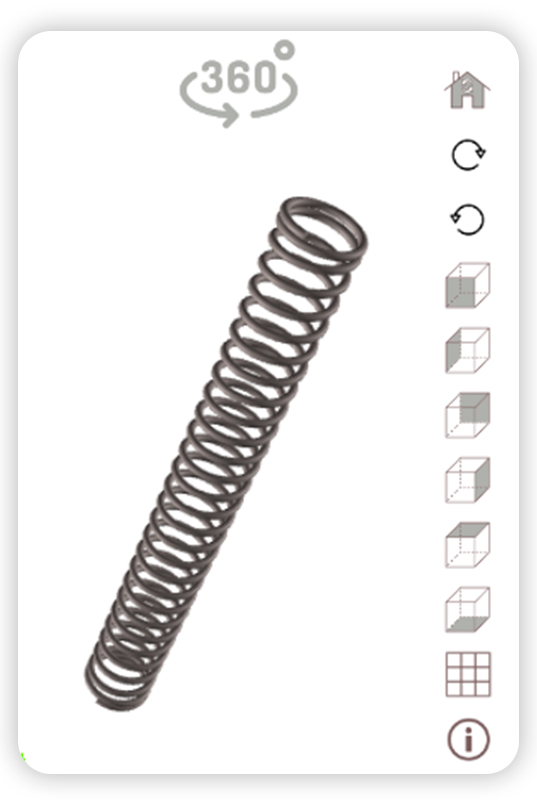
Let's imagine you are designing a spring for a mechanical device that requires a specific force to compress by 0.5 inches distance. You need to use Hooke's Law to determine the force F required to compress the spring. The spring specifications are as follows:
|
Part Number |
PC025-250-28000-MW-2000-C-N-IN |
| Wire Diameter | 0.025 inches |
| Outer Diameter | 0.250 inches |
| Free Length | 2 inches |
| Material Type | Music Wire |
| Total Coils | 28 |
| Spring Rate k | 1.895 lbs/inch |
Solving for F
Using the formula F = k × x
F = 1.895 lbs/inch × 0.5 inches
F = 0.9475 pounds
This means the force required to compress the spring by 0.5 inches is approximately 0.9475 pounds.
Why Compression Spring Load Calculations Matter?
This calculation is essential for several key reasons:
- Safety and Reliability: Ensuring that the spring can handle the expected load safely which prevents overloading, which could lead to spring failure or system malfunction.
- Optimal Spring Selection: By knowing the spring's maximum load-bearing capacity, engineers can select the correct spring for their designs, preventing costly over-specification or under-design.
- Predictable Performance: The spring load calculation helps designers predict how a spring will behave in the intended application, ensuring consistent and reliable operation.
- Replacement Verification: When replacing or modifying an existing spring, the load calculation helps verify if the new spring meets the original design specifications.
Maximizing Your Spring Design with Spring Creator 5.0 and Online Tools
- Spring Force Formula & Spring Constant Equation: Understand the spring constant with formulas embedded in the Spring Creator software, ensuring precise calculations. It simplifies the process by allowing you to input your spring dimensions and instantly receive accurate results.
- Spring Calculator Physics: The comprehensive calculator helps you solve for spring constants, rates, and loads efficiently.
- Solid Height Calculator: Determine the solid height of compression springs using Acxess Spring's online tools.
Conclusion
Designing a spring based on spring force calculations involves determining how much load the spring needs to handle and how far it should compress or extend under that load. Using Hooke’s Law (F = k × x), you can calculate the ideal spring constant (k) by dividing the required force (F) by the desired deflection (x). Once you have the spring constant, you can adjust parameters like wire diameter, coil count, outer diameter, and material type to meet that value. Tools like Acxess Spring’s Online Spring Force Tester or Spring Creator 5.0 make this process much easier by letting you tweak these variables and instantly see if your spring will perform as expected.
Created by Luis Enrique Rayas
Spring Designer in Spring Calculation at Acxess Spring